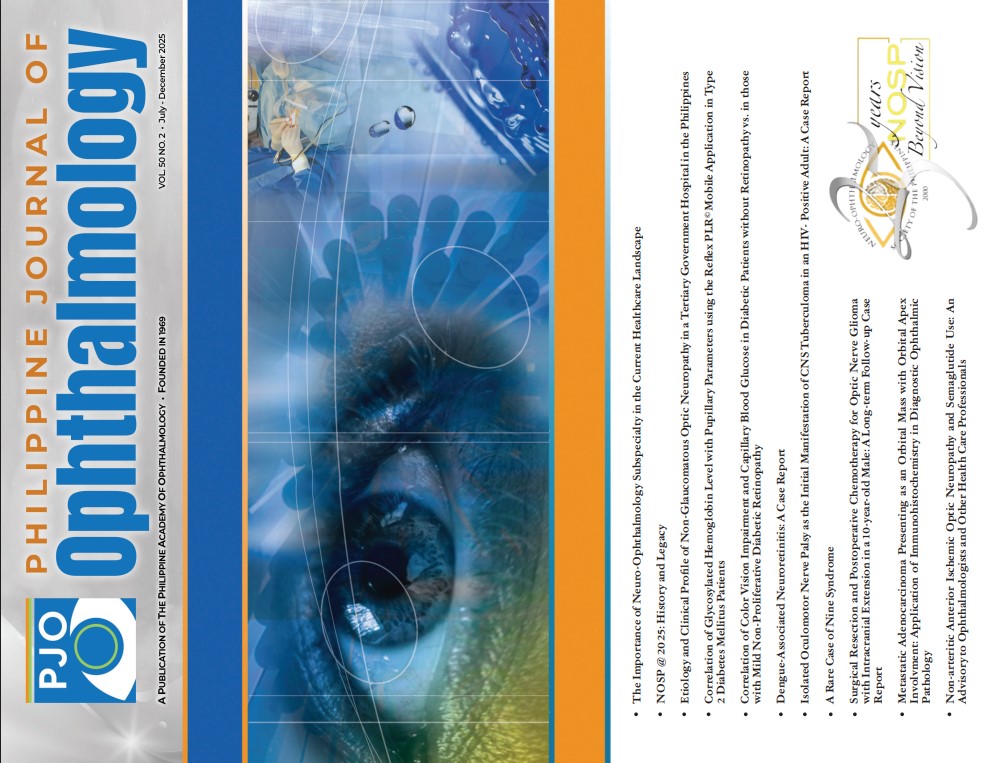
Correlation of Glycosylated Hemoglobin Level with Pupillary Parameters using the Reflex PLR© Mobile Application in Type 2 Diabetes Mellitus Patients
Keywords:
Diabetic autonomic neuropathy, pupillary light reflex, glycosylated hemoglobin, pupillometry, light reflex parametersAbstract
Objective: To determine the pupillary parameters of adult patients with type 2 diabetes mellitus (DM) using the Reflex PLR© mobile application and to correlate these parameters with glycosylated hemoglobin (HbA1C) levels.
Methods: This was a single-center, prospective, observational, cross-sectional study conducted at Ospital ng Makati from June to August 2024. Study participants were patients with type 2 DM without diabetic retinopathy and non-diabetics who served as the control group. Participants underwent blood chemistry testing and pupillometry using the Reflex PLR© mobile app. The study outcomes were maximum and minimum pupillary diameters, amplitude, and latency.
Results: There were 44 study participants: 26 non-diabetics and 18 diabetic patients. The two groups had similar pupillary baseline diameters (p = 0.72; p = 0.30), maximum pupillary diameters (p = 0.82; p = 0.89), minimum pupillary diameters (p = 0.85; p = 0.89), pupillary amplitudes (p = 0.88; p = 0.55), and pupillary latencies (p = 0.53; p = 0.47) for the right and left eyes, respectively. The relationship between pupillary parameters and HbA1C levels showed no significant variations in baseline diameter (p = 0.21; p = 0.45), maximum diameter (p = 0.65 for the right eye; p = 0.46 for the left eye), minimum diameter (p = 0.77; p = 0.46), amplitude (p = 0.89; p = 0.83), and latency (p = 0.31; p = 0.22).
Conclusion: The study did not demonstrate any significant correlation between pupillary parameters and HbA1C levels. Pupillary changes in diabetes may have been more dependent on factors such as disease duration and the presence of complications rather than glycemic control alone.
Published
Issue
Section
License
Copyright (c) 2025 Philippine Journal of Ophthalmology

This work is licensed under a Creative Commons Attribution-NonCommercial 4.0 International License.


